Basic HTML Version


OA – DF - YB – LB: Thermal Simulation And Interpretation - Part 1
p 8/10
6 - Thermal interpretation
The general question can be formulated as follows: ’from an input temperature profile, is it
possible to back-calculate the rates of the various inflow zones?’
We know that the temperature profile is an integral response influenced by the quantity and
the nature of the fluid produced. Many parameters come into play and have a strong coupling,
starting with the PVT description of the fluids. Our capacity to solve the inverse problem starts
with the ability to treat the direct problem properly. This can only be achieved (with a proper
model) if we have all the required parameters: thermal properties of the formation,
completion, reservoir properties and pressure, etc. Good PVT does also imply pressure
measurements so we need at least some pressure inside the wellbore and an estimate of the
layer (static) pressure.
Even in single phase non-uniqueness can arise. In section 3, we saw how the temperature
change inside the formation can be calculated based on the overall layer pressure drop (
Pe-P
).
If this value can be easily assessed for the bottom zone, it is not the case above and wrong
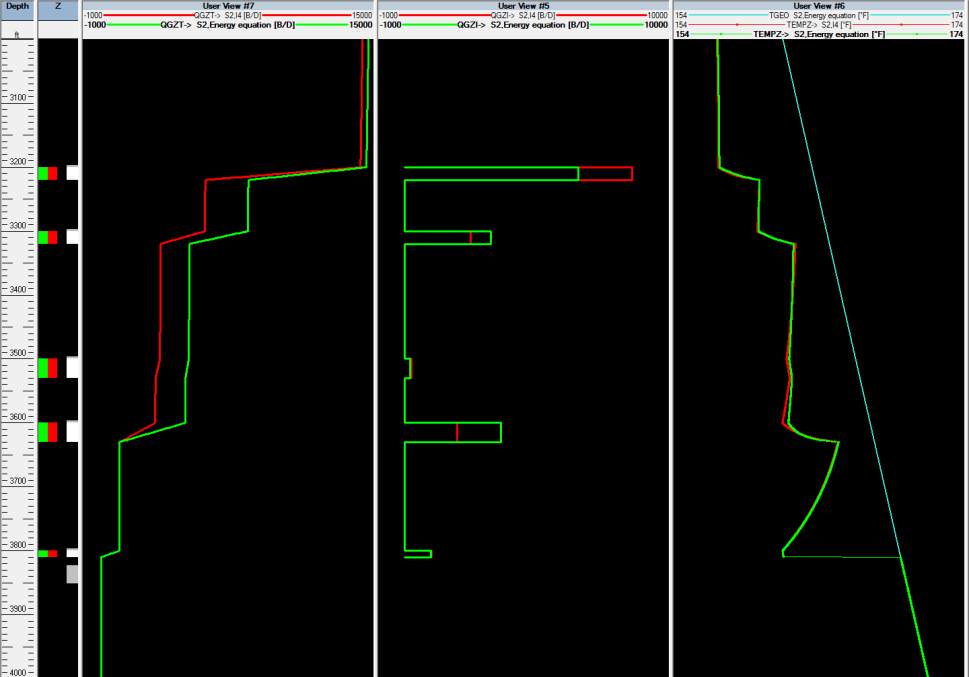
estimates will lead to wrong rates. The Figure below shows a gas case with 2 distinct splits
(QZT on track#1, QZI on track#2) corresponding to distinct assumptions of pressure drops,
that lead to almost identical thermal profiles (and total rates).
Single phase gas: two distinct assumptions of layer pressure drops
produce the same thermal response with different rate splits
dP, psia= [
500
-
600
,
500
-
500
,
500
-
600
,
500
-
400
,
500
-
500
]