Basic HTML Version


OA – DF - YB – LB: Thermal Simulation And Interpretation - Part 1
p 4/10
0
~
2
2
1
2
1
2
1
1
2
2
2
2
2
2
2
2
2
s
sf
wb
sf
is
sf
sf
is
s
s
s
s
s
s
s
s
s
T T D
dl
g
q
A
h q
q
A
h q dl g
q
A
h
Q E
The energy balance is written below in discretized form on a well segment with the notations of
the Figure (
1
E
=wellbore,
2
E
=reservoir). Note that we refer to mass rate by
q
and to
volumetric rates by
Q
.
The terms with a tilde are for average segment pressure and temperature. In these equations
the enthalpies (
h
), densities (
ρ
) and flow rates (
q, Q
) are those of the fluid mixture. An
important difference with Rubis is that Emeraude uses a Black-Oil PVT and the enthalpy is
expressed from this model. First, the phase enthalpy is obtained using the integration on T and
P as described before, from the coefficient of thermal expansion of the fluid, and the specific
heat capacity. Mixture properties are defined as a mass weighted average of the phase
properties.
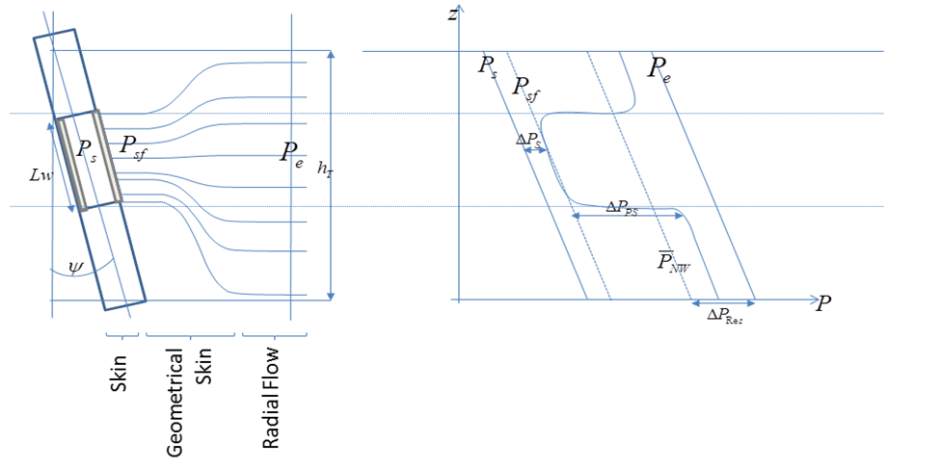
To close the system we need to know the sandface and the reservoir pressures
sf
P
and
e
P
T
hese are either input by the user or computed based on well and reservoir information. The
computation uses the steady-state pressure drop equation; it involves the reservoir properties,
the mechanical Skin (
S
)
the geometrical Skin (
G
S
):
The pressure drops are computed iteratively at the average wellbore segment pressure point
and flowing wellbore temperature. The geometrical Skin depends on the slant, the anisotropy,
the geometry of the perforations relative to the formation. It is evaluated from Chen et al.
(1995) with anisotropic correction from Pucknell & Clifford (1991).
0
~
2
1
2
2
2
2
geo
sf
res
s
sf
wb
res
sf
is
sf
sf
is
T T D T T D h
q
A
h q E
]
)
ln(
[
2
)
(
G
T
T H
s
e
se
S
rw
re
S
Lw
h
h k
Q
PP P