Basic HTML Version


OA – DF - YB – LB: Thermal Simulation And Interpretation - Part 1
p 5/10
The thermal conductance terms are defined as:
) /
ln( /
2
*
w e
res
res
r r
dL
D
w
wb
r dL U D
2
U is the overall heat transfer coefficient between the wellbore and the formation.
Note: Despite the introduction describing this model as a steady-state simplification of the
Rubis model two transient corrections are considered. One affects the conduction term from
the wellbore to the reservoir; the other one introduces a correction in the reservoir convection
term which is equivalent to a transient Joule-Thomson effect. The latter is applicable only for
liquids, and it affects the solution only with very low rates and high porosity.
4 - Rubis vs. Emeraude model comparison
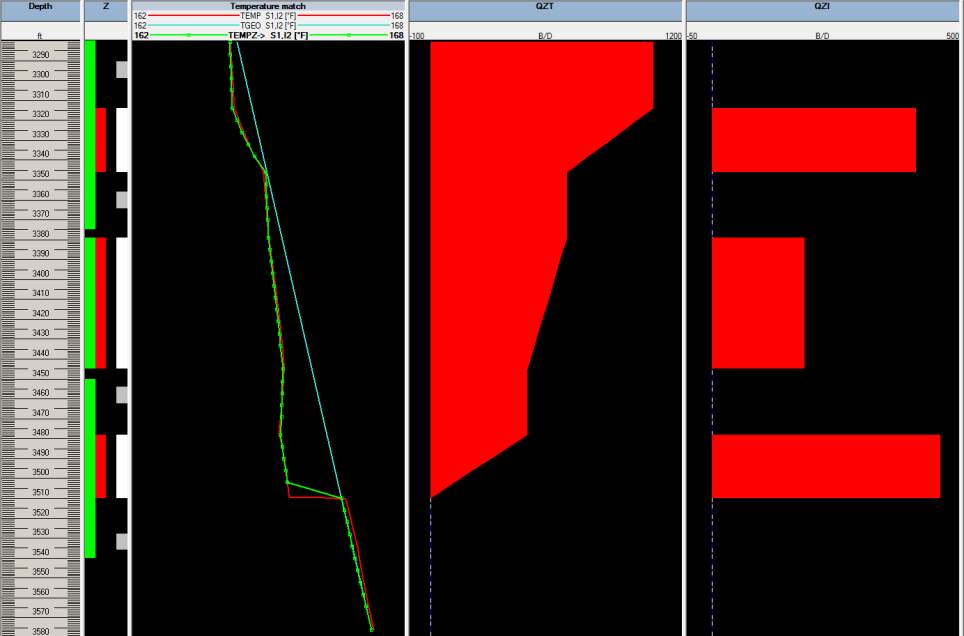
A number of single phase comparisons have been made between the two models. Below is an
illustration with Emeraude Guided Session B10. The temperature match view in track#1 shows
the Emeraude flowing temperature (green) overlaying the Rubis profile (red) for the same
rates.
Surface: Qg=1MMscfD - Temp:
Rubis
,
Emeraude
In multi-phase the comparison can only hold if the PVTs are identical. However, since Rubis
uses a compositional PVT while Emeraude uses Black-Oil correlations, it is difficult to have
exactly the same input.