Wavelet I
This algorithm of denoising requires that the data points are evenly spaced. Prior to applying the algorithm, data is resampled at equal intervals. Denoising is then performed on the resampled evenly spaced data. This method is sensitive to data with large gap duration's due to the resampling approach as artificial data points can be created by data interpolation. Therefore, it is advisable to adequately set the minimum gap duration to exclude sections with no data points.
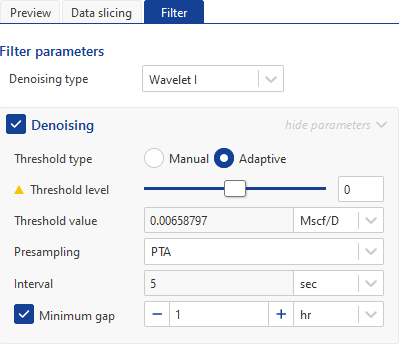 |
Presampling — This option is accessible only with Wavelet I denoising. Three preset values and a user defined option are available. As a rule, it is not advisable to resample data with a higher frequency than the acquisition frequency of the raw gauge data due to the creation of artificial data points.
PTA — is suitable if the filtered data is primarily targeted for pressure transient analysis. This method sets resampling time to 1 second, however if the min time between real data points is more than 1 second then the later will applied. This serves as a guard against generating large numbers of artificial data points in cases when the raw gauge data was acquired with a much lower sampling frequency.
Intermediate — This method is applicable for cases when the filtered dataset is used for both pressure transient analysis and production analysis. The resampling interval in this case is set to 15 seconds.
PA — In cases where the filtered data is considered only for production analysis the 5-minute interval best serves this purpose.
User — This setting allows the user to manually set any custom resampling time.
Minimum Gap — The minimum gap duration option defines the minimum time interval between two consecutive data points for them to be regarded as a continuous stream of data. Any gap that exceeds this interval is considered as absent data. This setting is used in Wavelet I denoising algorithm. Time gaps that exceed this value will not be interpolated with extra data points.